From Advertising to Automation: How AI Is Transforming the eCommerce Industry
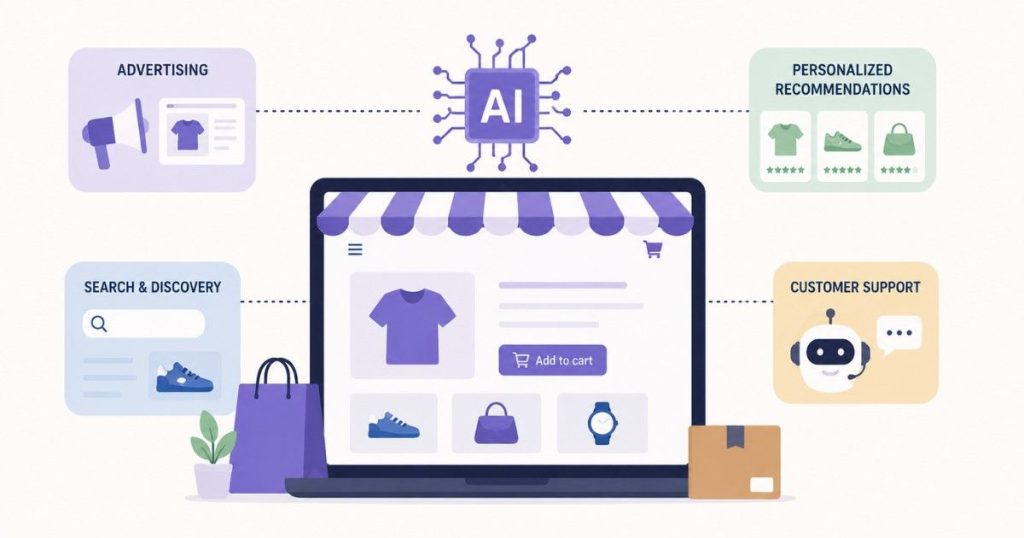
Artificial intelligence is rapidly reshaping the global eCommerce industry, with businesses increasingly using AI-powered tools across advertising, customer engagement, logistics, inventory management, and automation to improve efficiency and drive sales growth.
As digital commerce becomes more competitive, online retailers are turning to AI technologies to personalise shopping experiences, reduce operational costs, and streamline backend processes. Industry experts say AI is no longer a futuristic concept in eCommerce it is becoming a core business necessity.
AI Changing the Way Online Retail Operates
AI applications in eCommerce now extend far beyond product recommendations and chatbots. Companies are increasingly integrating machine learning, predictive analytics, automation systems, and generative AI into nearly every stage of the customer journey.
From targeted advertising campaigns to warehouse management, AI is helping businesses make faster and more data-driven decisions.
AI-Powered Advertising and Customer Targeting
One of the biggest applications of AI in eCommerce is digital advertising optimization.
AI tools help businesses:
- Analyze customer behaviour
- Predict purchase intent
- Personalise advertisements
- Improve ad targeting accuracy
- Optimize marketing budgets
Platforms increasingly use AI algorithms to determine which products, offers, and advertisements users are most likely to engage with.
Personalized Shopping Experiences
AI-driven recommendation engines have become central to modern eCommerce platforms. These systems analyze browsing patterns, purchase history, and customer preferences to deliver personalized product suggestions in real time.
This personalization helps improve conversion rates and customer retention.
Automation Streamlining Backend Operations
AI is also transforming operational efficiency within eCommerce businesses through automation.
Inventory Management
Retailers are using AI to forecast demand, track stock movement, and reduce inventory waste. Predictive systems help companies avoid overstocking and stock shortages.
Warehouse and Logistics Optimization
AI-powered logistics systems can optimize delivery routes, warehouse organization, and shipping timelines. Automation in fulfilment centres is helping businesses process orders faster and reduce human error.
Customer Service Automation
Chatbots and virtual assistants powered by AI are increasingly handling customer queries, refunds, and order tracking requests. This allows companies to provide 24/7 support while reducing operational workload.
Generative AI Emerging as New Growth Area
Generative AI tools are now being adopted for:
- Product description generation
- Marketing content creation
- AI-generated images and ads
- Automated email campaigns
- Personalized shopping assistance
The rise of generative AI is enabling smaller businesses to scale content and marketing operations more efficiently.
Why AI Adoption Is Accelerating in eCommerce
Several factors are driving AI adoption across online retail:
- Growing competition in digital commerce
- Rising customer expectations
- Need for operational efficiency
- Increased data availability
- Expansion of cloud computing and AI tools
Businesses are increasingly viewing AI investment as essential for maintaining competitiveness.
Challenges Businesses Still Face
Despite rapid adoption, implementing AI in eCommerce comes with challenges:
Data Privacy and Security
Handling large amounts of customer data raises privacy and compliance concerns.
High Implementation Costs
Advanced AI infrastructure and integration can require significant investment.
Dependence on Quality Data
AI systems rely heavily on accurate and high-quality data for effective performance.
Workforce Adaptation
Businesses must train employees to work alongside AI-powered systems and automation tools.
AI and the Future of eCommerce
Industry analysts believe AI will continue transforming eCommerce over the next decade, particularly through hyper-personalization, voice commerce, predictive shopping, and autonomous logistics systems.
Companies that successfully integrate AI into both customer-facing and operational workflows may gain significant competitive advantages in the evolving digital retail market.
Outlook
As AI technologies become more accessible and scalable, adoption across the eCommerce ecosystem is expected to accelerate further. From advertising optimization to full-scale operational automation, AI is increasingly becoming one of the defining technologies shaping the future of online commerce.
Also read: EaseMyTrip Reports Double-Digit Growth in Airport Service Adoption as Travel Demand Rises
Add Pioneer Today as a preferred source on Google – Click Here
Last Updated on: Thursday, May 7, 2026 10:59 am by Koushik Velpuri | Published by: Koushik Velpuri on Thursday, May 7, 2026 10:59 am | News Categories: Technology
About The Author