
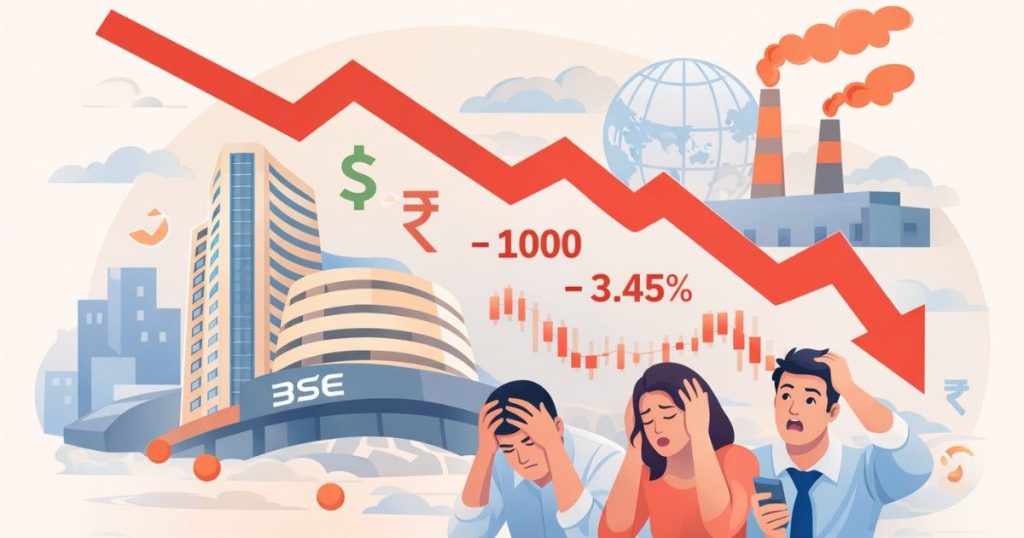


IT Bloodbath in Indian Stock Market sentiment gripped Dalal Street on Tuesday as the Sensex plunged more than 1,000 points and the Nifty fell below the 25,500 mark in a broad-based sell-off. Investors saw over ₹3 lakh crore wiped out in a single trading session amid rising global trade uncertainty and escalating geopolitical tensions. Heavy selling in frontline IT stocks intensified the decline, as concerns grew over a proposed 15% global import levy by U.S. President Donald Trump and mounting tensions between the United States and Iran.
Heavy selling in frontline IT stocks deepened the fall, with investors reacting to uncertainty surrounding U.S. President Donald Trump’s proposed 15% global import levy and rising tensions between the United States and Iran. The sharp decline erased more than ₹3 lakh crore in market capitalisation within a single trading session, according to provisional exchange data.
Global Trade Concerns Weigh on Sentiment
Investor sentiment turned cautious following renewed uncertainty over trade policy in the United States. U.S. President Donald Trump has proposed a 15% global import levy, a move that has sparked concerns about a potential escalation in trade barriers. While detailed policy execution remains unclear, the announcement has added to global market volatility.
Analysts say such measures could impact global supply chains and corporate earnings, particularly for export-driven economies. Indian IT services companies, which derive a significant share of their revenues from North America, are seen as vulnerable to changes in U.S. trade and corporate spending policies.
Adding to the uncertainty are rising tensions between the United States and Iran. Heightened geopolitical risks have pushed global investors toward safer assets, leading to outflows from emerging markets, including India.
IT Majors Under Pressure
Shares of leading IT firms including Tata Consultancy Services, Infosys, and HCL Technologies fell sharply during the session. The Nifty IT index was among the worst-performing sectoral indices.
Brokerage analysts noted that IT companies are facing multiple headwinds. Apart from global trade uncertainty, there are growing concerns about structural shifts in the industry. Rapid adoption of artificial intelligence tools is changing traditional outsourcing models. Companies are increasingly investing in automation and AI-driven platforms, which may reduce demand for certain legacy services.
While large Indian IT firms have been expanding their AI capabilities and digital transformation offerings, investors remain cautious about the pace of transition and potential margin pressure during the shift.
Market Capitalisation Erodes
The broader market also felt the impact of the sell-off. Mid-cap and small-cap stocks declined alongside frontline indices. Data from exchanges indicated that the combined market capitalisation of listed companies fell by more than ₹3 lakh crore during the trading session.
Banking, auto, and metal stocks also traded lower, reflecting widespread risk aversion. Analysts said foreign portfolio investor (FPI) activity will be closely monitored in the coming days, as global funds reassess exposure to emerging markets.
Domestic Fundamentals Remain Stable
Despite the sharp fall, market experts pointed out that India’s domestic economic indicators remain stable. Inflation has shown signs of moderation in recent months, and corporate earnings have largely met expectations in recent quarters.
However, short-term volatility may persist as investors track global developments. “Markets are reacting to external risks rather than domestic weakness,” a senior market strategist at a Mumbai-based brokerage said, adding that clarity on global trade policy could help stabilise sentiment.
What Investors Should Watch
Market participants are now closely watching for official details on the proposed U.S. import levy and any diplomatic developments in West Asia. Corporate commentary from Indian IT firms regarding client spending trends and AI-led transformation strategies will also be in focus.
Traders expect heightened volatility in the near term. However, long-term investors are likely to evaluate fundamentals and earnings visibility before making allocation decisions.
For now, the “IT bloodbath” has underlined the sensitivity of Indian markets to global shocks. With over ₹3 lakh crore in investor wealth eroded in a day, caution is dominating Dalal Street as geopolitical and trade uncertainties continue to unfold.
Also read: Trump 10% Tariff India Impact: Dramatic 10% vs 18% Shift Sparks Investor Shock Before Monday Markets
Add Pioneer Today as a preferred source on Google – Click Here